
A guide to a calmer, more organised home
How to keep your home tidy without constantly cleaning up
Seven habits that create a system in which things naturally return to their place—without losing weekends to major clean-ups.
Start with the first habitA tidy home is not the result of constant cleaning up. It comes from a few good decisions that reduce how often you need to decide where something belongs.
The biggest problem is often not a lack of willpower, but a lack of a system. Items have no clear home, frequently used things sit behind rarely used ones, and boxes become anonymous storage. Every clean-up then demands extra energy: look at the item, make a decision, and find room for it.
These seven habits shift the focus from occasional major efforts to small patterns that work every day. You do not need to become a minimalist or give up things you love. The goal is to know what you have, where it is, and who is responsible for returning it.
Tidiness is not a permanent state. A home is used, changes, and occasionally becomes messy. A good system does not prevent every mess; it shortens the way back.
System before discipline
Seven habits that make a difference
Give every item a permanent home
When keys, chargers, or school supplies do not have an address, they end up on the first free surface. Choose one logical, easy-to-reach place for each group of items. Keys can sit in a shallow tray by the entrance, chargers in a labelled drawer, and post in one folder that is emptied once a week.
The place must match real behaviour, not an ideal picture of your home. If bags always land by the door, put a hook or basket there. A good system follows the shortest natural path, which makes it easier to maintain even when you are tired.
Organise by how often things are used
The easiest-to-reach shelves and drawers belong to things you use every day. Items for special occasions can go higher, deeper, or into storage. Taking things out and putting them back then becomes simple, and clutter does not appear just because you must move three items to reach a fourth.
Watch what you actually use for one week. A kitchen appliance used once a year does not need to occupy the worktop, while your favourite mug should not sit on the highest shelf. Adapt the arrangement to the seasons: winter gear can move farther into storage during summer, while summer items stay close at hand.
Use a simple three-zone rule. The first is within arm’s reach for everyday items. The second requires one extra action, such as opening a cupboard, and suits weekly use. The third can be a high shelf, basement, or storage room for seasonal and rarely used belongings.
Use boxes that are organised, not merely full
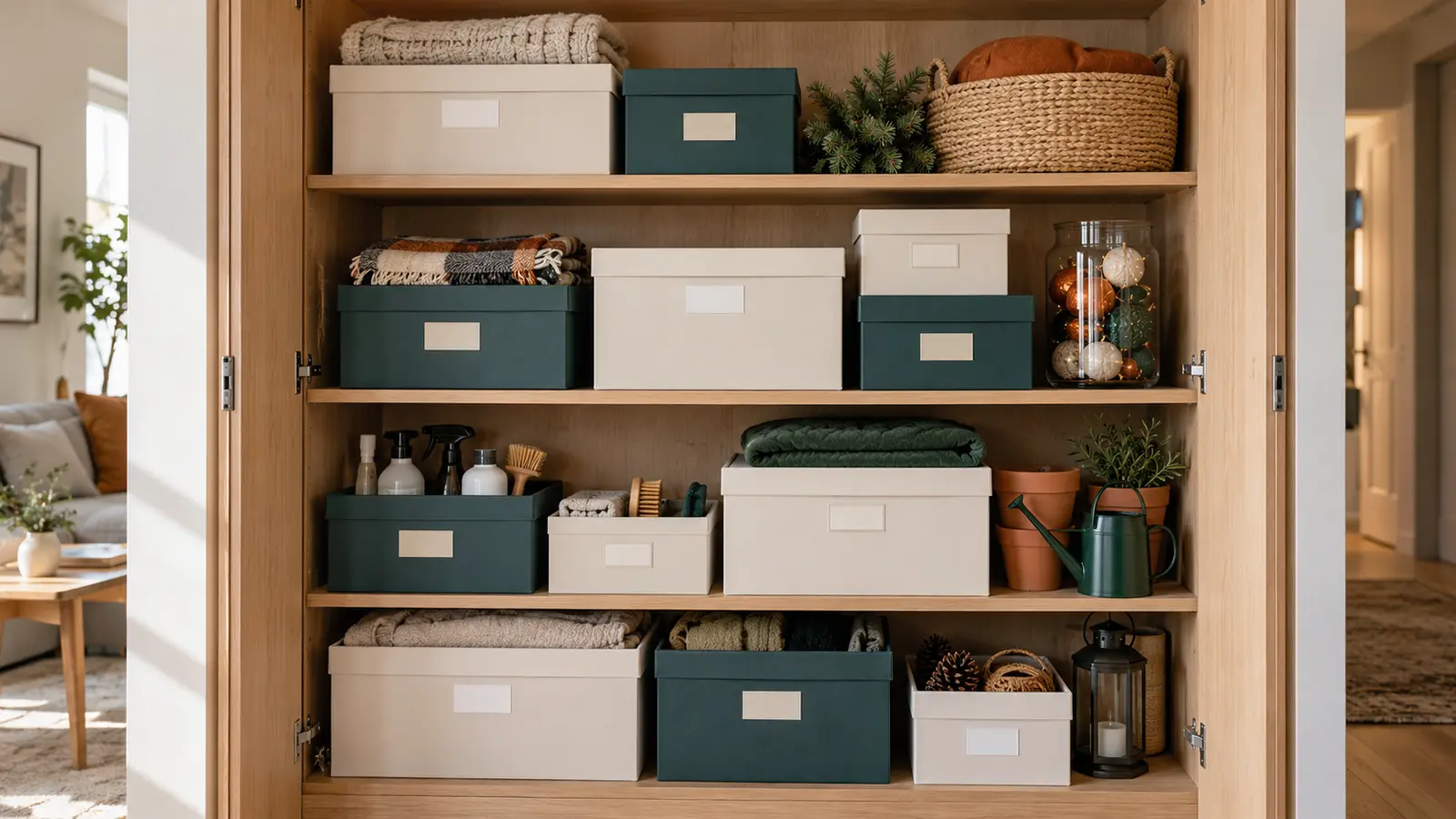
A box does not create order by itself. If you put everything without a home into it, you have only moved the clutter behind a lid. Every box needs a clear purpose: “Christmas decorations”, “cables and adapters”, or “children’s clothes, age 4”, instead of a vague “miscellaneous”.
Do not fill boxes to the limit. Leave enough room to remove an item without emptying everything. Group the contents with smaller dividers or bags, and put the label on the side you can see from where you access it. If the contents change often, use replaceable labels and check occasionally that the name still matches reality.
Create a short daily routine
Ten minutes at the end of the day is often worth more than two hours on Saturday. Choose a regular moment—before relaxing in the evening or after the children go to bed—and focus only on returning things to their places, clearing the main surfaces, and preparing for the morning.
Set a timer so the routine does not turn into a deep clean. Start with the room that has the greatest effect on your sense of calm, usually the kitchen or living room. Stop when the time is up. The goal is not perfection, but consistency that prevents build-up.
“Your home does not need to look like a catalogue. It only needs to stop slowing you down.”
Share responsibility across the household
Order is not one person’s job. Everyone who uses the space should understand the system and be able to follow it. Agree on simple rules: everyone returns their own things, shared surfaces remain clear, and tasks have a specific owner instead of an undefined “someone will do it”.
Set shelves at a suitable height for children and use picture labels. Adults benefit from a simple division of zones or days, without complicated charts. When everyone knows where things belong, there are fewer questions, less shifting of responsibility, and less hidden mental load.
If a rule keeps failing, do not immediately blame the people in the home. The basket may be too far away, the label unclear, or the shelf already full. Change the system together and test it for a few days. Organisation works only when everyone understands it and it is easy enough to use every day.
Digital support for a real home
Create a digital inventory
When things are stored out of sight, it is easy to forget that you own them. A digital inventory helps you find an item without opening every box and prevents unnecessary duplicate purchases.
In Spremly, you can organise items according to real spaces and subspaces. Connect a box to its digital contents with a QR code, then scan it to reach the list without rummaging.
Example location
Scan the label on the box
Open its digital contents instantly.
The owner can share a selected space together with its subspaces and items. The private inventory stays separate, while the household sees what it needs.
Review what you keep from time to time
Even the best system gradually fills with items that no longer serve a purpose. Every three or six months, review one category or zone. Ask whether you use the item, whether you would buy it again, and whether it justifies the space it occupies.
You do not need to review the whole home at once. One drawer, shelf, or box a week is enough for steady progress. Sort items into keep, move, donate, repair, and recycle or dispose of responsibly. If something stays, return it to a clear place immediately and update its label or digital inventory.
Quick start
Your first 15-minute reset
- 1Choose one surface that bothers you every day.
- 2Return the items that already have a home.
- 3Give the five remaining items a permanent address.
- 4Label one box with a specific name.
- 5Choose a time for tomorrow’s ten-minute routine.
This small circuit creates a visible change and reveals where the system gets stuck. Repeat it in another zone next time.
Frequently asked questions
What else is worth knowing?
How can I keep my home tidy every day?
Give things permanent homes, make frequently used items easy to reach, and create a short returning routine. The system should follow the way your household actually lives.
How long should a daily tidy take?
For most homes, about ten focused minutes is enough to prevent build-up. Do larger reviews occasionally, one zone at a time.
How do I know what is inside closed boxes?
Use precise labels and a digital inventory. Spremly can connect a box to a list of its contents with a QR code.
How can I share a home inventory while keeping other items private?
The owner can share a selected space together with its subspaces and items. The private inventory remains separate.
Know what you own and where it is.
Organise your home by spaces and subspaces, connect boxes with QR codes, and share only the spaces your household needs.